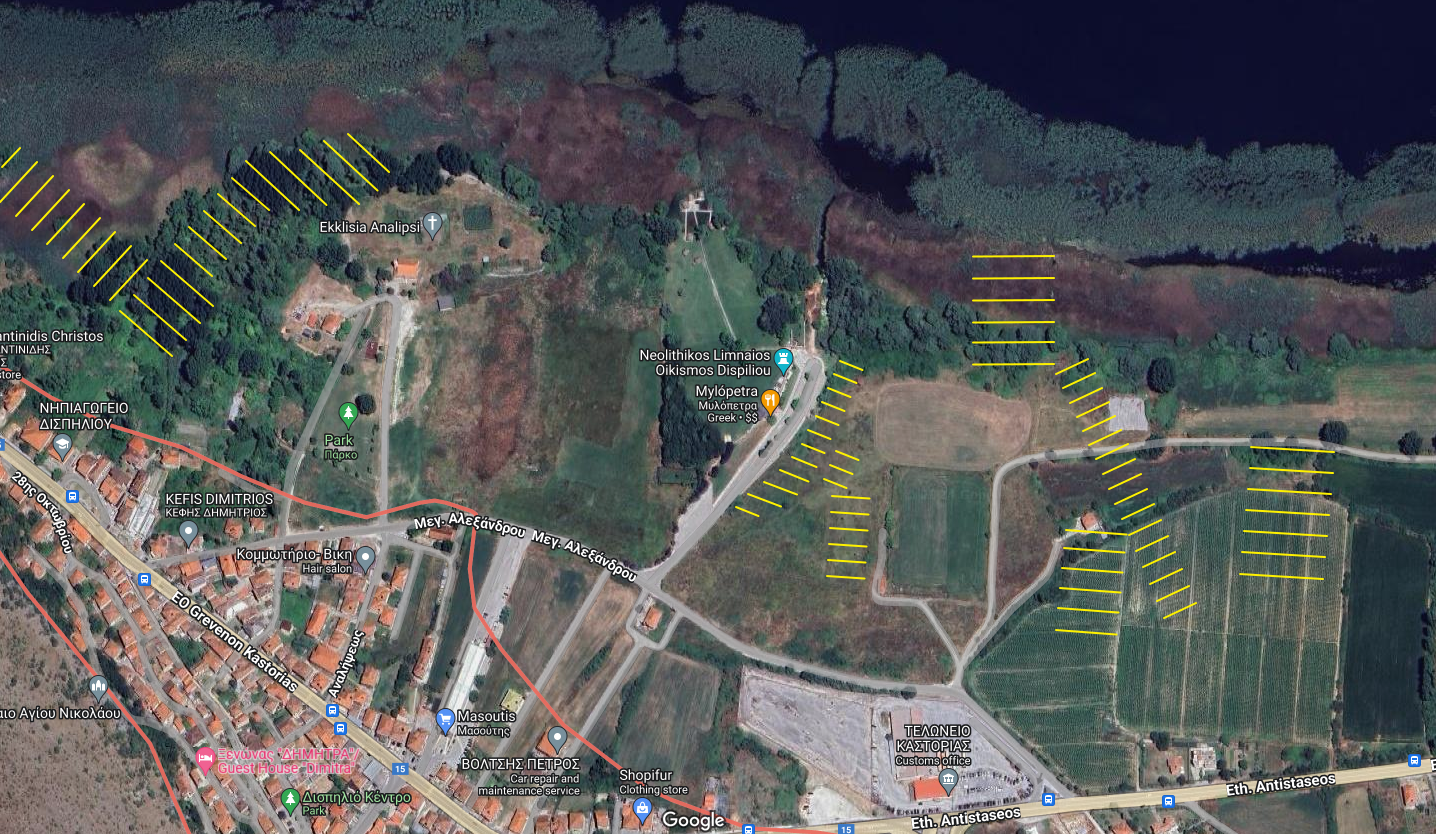
Dispilio is a prehistoric lakeshore settlement near Lake Kastoria in Western Macedonia, Greece, discovered during a dry winter in 1932. Systematic excavations began in 1992 under Professor George Hourmouziadis of Aristotle University of Thessaloniki. The site, occupied from roughly 5600–3000 BC, is exceptional for its preservation of wooden structures, flutes, organic material, and the famed Dispilio Tablet — a wooden plaque inscribed with linear signs dated to around 5260 BC. It remains one of Europe’s most important Neolithic settlements.
1992–2005 – Foundational Excavations under Professor George Hourmouziadis
Although excavation began in 1992, the foundational archaeological framework spanning through 2005 was dominated by Professor George Hourmouziadis, Professor of Prehistoric Archaeology at Aristotle University of Thessaloniki. His team uncovered pile-built houses, clay and wooden structural elements, delicate organic artifacts, three bone flutes (among Europe’s oldest), and the Dispilio Tablet. These finds provided evidence for long-term settlement from Middle to Final Neolithic. The excavation was primarily supported by Aristotle University and informal publication channels.
2005–2015 – Radiocarbon and Dendrochronological Chronology Refinement
Between 2005 and 2015, researchers associated with Aristotle University applied wiggle-matched radiocarbon dating and dendrochronological analysis to wooden posts. These studies, led by Dr. Tryfon Giagkoulis (archaeologist, Aristotle University of Thessaloniki) and Dr. Kostas Kotsakis (archaeologist, National and Kapodistrian University of Athens), refined phases of settlement around 5600 cal BC, a dense building episode around 5300 cal BC, and later occupation until 3000 BC. The results supported multi-phase habitation and continuous architectural development on stilts.
2016–2020 – Digital Representation and ERC EXPLO Project
The European Research Council funded the EXPLO project from 2016 to 2020, led by Dr. Kostas Kotsakis and Dr. Tryfon Giagkoulis, in collaboration with the Helike Project framework. GIS mapping, 3D photorealistic documentation, and analysis of spatial data — conducted by Dr. Filippos Stefanou (digital archaeologist, Aristotle University of Thessaloniki) — captured wood species distribution and settlement layout, especially in the eastern sectors. This digital documentation enhanced interpretative models of Neolithic lake-based urbanism.
2021–2023 – Public Display and Conservation at the Archaeological Site
During 2021–2023, local authorities and Aristotle University oversaw reconstruction and conservation efforts at the site. Wooden huts mimicking Neolithic dwellings were built on stilts in the open-air exhibition, based strictly on excavation evidence. Display infrastructure and museum facilities were developed, along with public educational programs. This phase was led by site archaeologists Dr. Maria Nikolaidou (Aristotle University of Thessaloniki) and Dr. Giorgos Petropoulos (cultural heritage officer, Kastoria Regional Authority), funded through municipal and regional cultural heritage initiatives.
2024–2025 – Interdisciplinary Studies of Ideological Behavior and Symbolism
Recent efforts in 2024–2025, conducted by the original excavation team’s continuity researchers, focused on interpreting the symbolic and ideological dimensions of the settlement. Studies examined the Dispilio Tablet and bone/flute artifacts, considering whether the linear signs could represent proto-writing. Analytical work was performed by experts in prehistoric symbols and cognitive archaeology, including collaboration with radiocarbon labs. Key contributors included Dr. Elena Papadopoulou (cognitive archaeologist, University of Crete) and Dr. Andreas Mavridis (specialist in prehistoric symbols, National Hellenic Research Foundation). The interpretation remains cautious, reflecting the tablet’s context and preservation.
Summary
The archaeological sequence at Dispilio spans from foundational excavations led by Professor George Hourmouziadis (1992–2005), through precise chronometric studies by Dr. Tryfon Giagkoulis, Dr. Kostas Kotsakis, and their colleagues, to digital documentation under an ERC-funded program, public conservation and reconstruction, and symbolic analysis of unique artifacts. Systematic excavation, scientific dating, spatial modelling, and exhibition efforts have revealed a multi-phase lakeside Neolithic settlement with agricultural, architectural, and potential symbolic complexity. The site continues to provide rare and essential insights into prehistoric wetland urbanism and early human cognition.