
Pacopampa is a ceremonial site located in the Cajamarca highlands of northern Peru, belonging to the Formative period (c. 1200–500 BC). It features monumental stone architecture, sunken plazas, and large platforms. Notable finds include elaborate burials, ritual artifacts, and evidence of social hierarchy. The site has been the focus of a joint Peruvian–Japanese research programme since 2005, revealing the early development of religious authority and elite society in the northern Andes.
2005–2015 – Formal Project Establishment and Discovery of the Lady of Pacopampa
In 2005, the Pacopampa Archaeological Project commenced under a collaboration between the National University of San Marcos (Peru) and the National Museum of Ethnology, Osaka (Japan), led by Professor Yuji Seki (Project Director, National Museum of Ethnology, Osaka) and co-director Dr. Daniel Morales Chocano (Associate Professor, National University of San Marcos). Excavations during this period revealed the ceremonial plaza, monumental platforms, and the elite burial of a woman known as the Lady of Pacopampa (around 900 BC), interred with gold earrings, a cinnabar-coated skull, and shell necklaces. The project’s success established Pacopampa’s chronological sequence and ritual significance.
2010–2015 – Serpent-Jaguar Priests Tombs and Monumental Architecture Analysis
Continuing field seasons led by Seki and Morales during this phase uncovered the Jaguar Serpent Priests tombs (c. 700–600 BC) near the third sunken platform. These burials contained gold jewelry and ritual objects associated with local elite. Researchers including Dr. Juan Pablo Villanueva (Archaeologist, National University of San Marcos) and Dr. Masato Sakai (Researcher, National Museum of Ethnology, Osaka) documented architectural modifications and stratigraphy across platforms, helping define the Pacopampa II phase. Ritual stratigraphy and elite burials demonstrated the emergence of priestly elites and centralized ceremonial activity.
2015–2020 – Radiocarbon Chronology and Isotopic Analysis
Between 2015 and 2020, teams led by Seki, Morales, and Villanueva, along with collaborators at UNMSM, integrated radiocarbon dating, osteological study, and isotopic analysis, such as camelid tissue studies by Dr. Mai Takigami (Isotope Specialist, National Museum of Ethnology, Osaka). These analyses refined the dating of the Pacopampa I, II, and III phases and clarified dietary and mobility patterns among elites, confirming long-term occupation and ritual continuity.
2022–2023 – Priest of Pacopampa Tomb Discovery
In August–September 2022, excavations led by Professor Yuji Seki and Dr. Juan Pablo Villanueva uncovered the tomb of a high-status male figure termed the Priest of Pacopampa, dating to around 1000 BC. The burial was found beneath six layers of ash and earth in a circular shaft (3 m diameter, 1 m deep), containing seals with jaguar and anthropomorphic motifs, ceramic offerings, and a carved bone spatula. The intact context suggested ecclesiastical function in early Andean temple society.
2024–2025 – Environmental, Symbolic and Public Interpretation Studies
Recent interdisciplinary work (2024–25) has focused on bioarchaeological interpretation of ideology, symbolism, and environmental reconstruction. Led by Dr. Juan Pablo Villanueva and Dr. Masato Sakai, the team examined ceremonial deposition patterns, cranial deformation, and landscape use. Collaboration with international specialists including Dr. Elena Papadopoulou (Cognitive Archaeologist, University of Crete) and Dr. Andreas Mavridis (Prehistoric Symbols Specialist, National Hellenic Research Foundation) explored the ideological dimensions of elite burials. These efforts were supported by academic grants and Peruvian cultural institutions.
Summary
Pacopampa has been investigated extensively under the leadership of Professor Yuji Seki and Dr. Daniel Morales Chocano, with major contributions from Dr. Juan Pablo Villanueva, Dr. Masato Sakai, isotope specialist Dr. Mai Takigami, and collaborators at the National University of San Marcos and Osaka’s National Museum of Ethnology. The research has documented ceremonial architecture, elite tombs such as the Lady of Pacopampa and the Priest of Pacopampa, ritual objects including seals and gold ornaments, and evidence of animal husbandry and socioreligious complexity. Pacopampa now stands as one of the most revealing Formative period sites in the Andes, illustrating early priestly authority, architectural ceremonialism, and long-term occupation in the northern highlands.
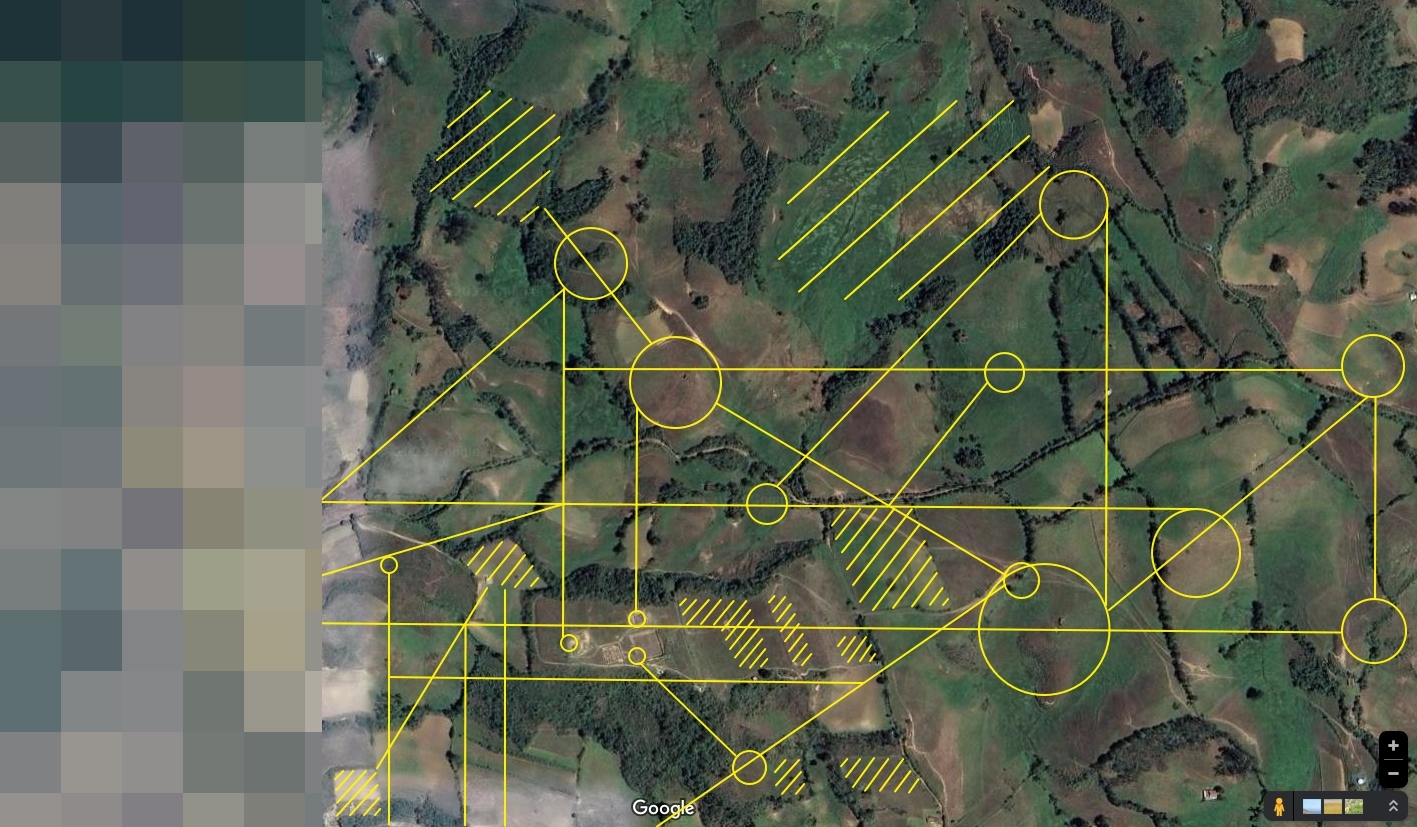
Location (-6.335205581461446, -79.03021414521633)
Shaded areas, separate lines, and circles indicate underground objects. Not all objects are shown in the diagrams. Complete information can be provided to professional specialists and teams with official status and the necessary permits.