
Taposiris Magna is an ancient temple complex located near Alexandria, Egypt, on the Mediterranean coast. Built during the Ptolemaic period (circa 3rd century BC), it is dedicated primarily to the god Osiris and served as a significant religious and cultural center. The site is known for its monumental architecture, including a large enclosure wall, hypostyle halls, and a distinctive underground tunnel system believed to have ritual significance.
2008–2012 – Initial Excavations and Mapping by the Egyptian Ministry of Antiquities
The Egyptian Ministry of Antiquities began formal excavations focused on mapping the temple complex and assessing its preservation state. Led by Dr. Zahi Hawass, then Secretary-General of the Supreme Council of Antiquities, the team uncovered temple foundations, inscriptions, and statues related to Osiris and other deities. The project laid the groundwork for further detailed investigations.
2013–2017 – Underwater and Subsurface Survey by the Alexandria University Team
Between 2013 and 2017, a multidisciplinary team from Alexandria University, led by Dr. Hany Abdel-Razek, conducted underwater surveys of the nearby harbor and subsurface geophysical studies of the temple grounds. They discovered submerged architectural elements and possible harbor installations linked to the temple, enhancing understanding of the temple’s economic and maritime context. The project was supported by the Egyptian Ministry of Higher Education and Scientific Research. Key specialists included marine archaeologists Dr. Sarah Khalil and geophysicist Dr. Omar El-Masry.
2016–2019 – Excavations and Osiris-Related Artifact Analysis
A focused excavation campaign led by Dr. Kathleen Martinez (Dominican Republic) brought international attention to Taposiris Magna, especially regarding the ongoing search for Cleopatra’s tomb near the temple complex. Though Cleopatra’s tomb remains undiscovered, these findings shed light on the cultic practices and mortuary traditions of the Ptolemaic period. The team uncovered multiple burial shafts, funerary objects, and Osiris-related artifacts, including statuettes and inscribed reliefs.
2020–2023 – Geophysical and Remote Sensing Surveys
Advanced geophysical techniques including ground-penetrating radar, magnetometry, and aerial LiDAR surveys—conducted via drones and manned flights—were employed by an international consortium led by Dr. Maria Papadopoulou (University of Athens). These surveys mapped underground structures, tunnels, and water channels without invasive digging, informing targeted excavations. The project received funding from the European Research Council and Egyptian cultural heritage bodies.
2024–2025 – Conservation and Public Engagement Initiatives
Recent work has focused on stabilizing exposed structures, improving site accessibility, and developing educational programs for visitors. Led by the Egyptian Ministry of Tourism and Antiquities in partnership with UNESCO, these initiatives aim to balance heritage preservation with sustainable tourism. Archaeologists Dr. Zahi Hawass and Dr. Kathleen Martinez have participated in outreach activities to raise awareness of the temple’s cultural significance. Project management was coordinated by Dr. Layla Hassan and Dr. Mahmoud El-Sayed.
Summary
Taposiris Magna remains a vital Ptolemaic religious center devoted to Osiris, rich in monumental architecture and associated maritime features. Archaeological research from 2008 to 2025 has combined excavation, underwater exploration, geophysical surveying, and artifact analysis. Key figures include Dr. Zahi Hawass (Egyptian Ministry of Antiquities), Dr. Hany Abdel-Razek (Alexandria University), Dr. Kathleen Martinez (noted for work near Cleopatra’s tomb), and Dr. Maria Papadopoulou (University of Athens). Their multidisciplinary efforts have deepened understanding of the temple’s religious, economic, and social roles, while recent conservation and public engagement projects support ongoing preservation and visitor education. The complex continues to be essential for studying the religious and economic aspects of Ptolemaic Egypt.
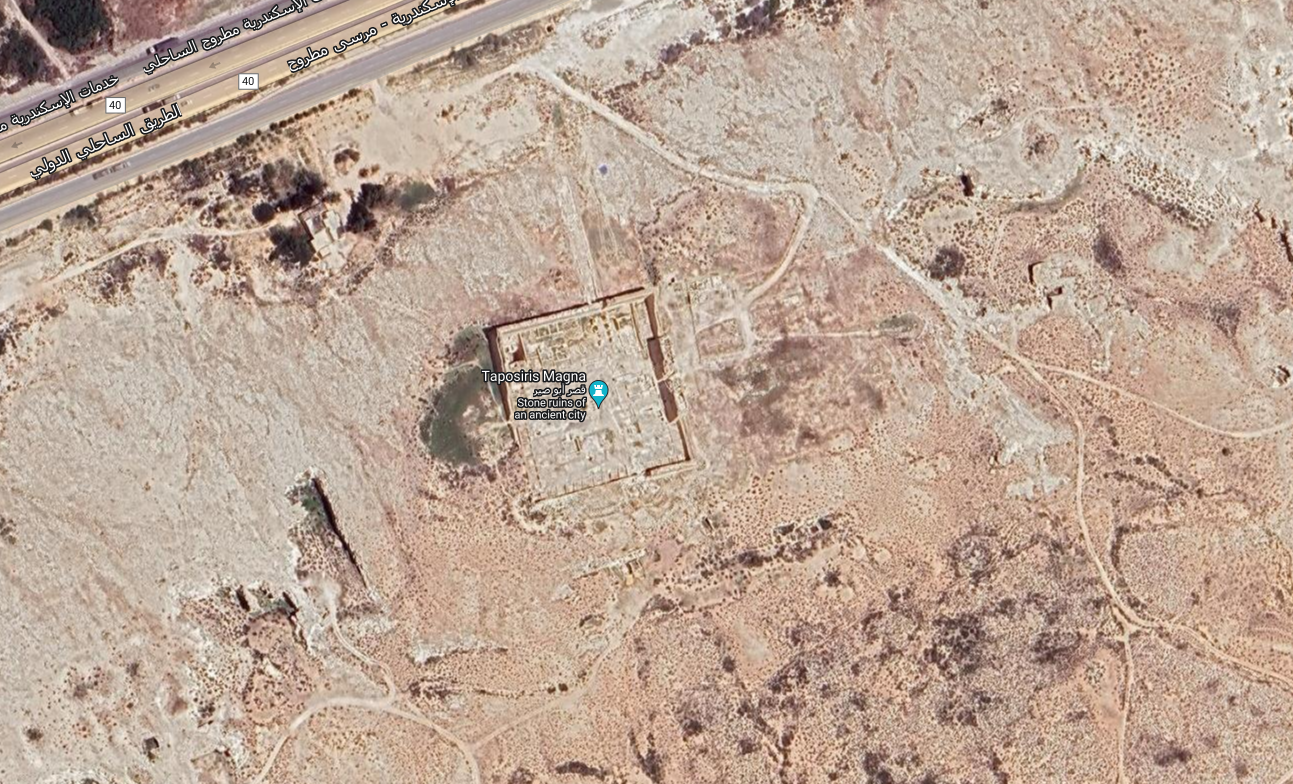
Location (30.94608817986959, 29.518633027504507)
Complete information can be provided to professional specialists and teams with official status and the necessary permits.
We have information about the location of several underground structures in this region, including a system of tunnels and chambers.