
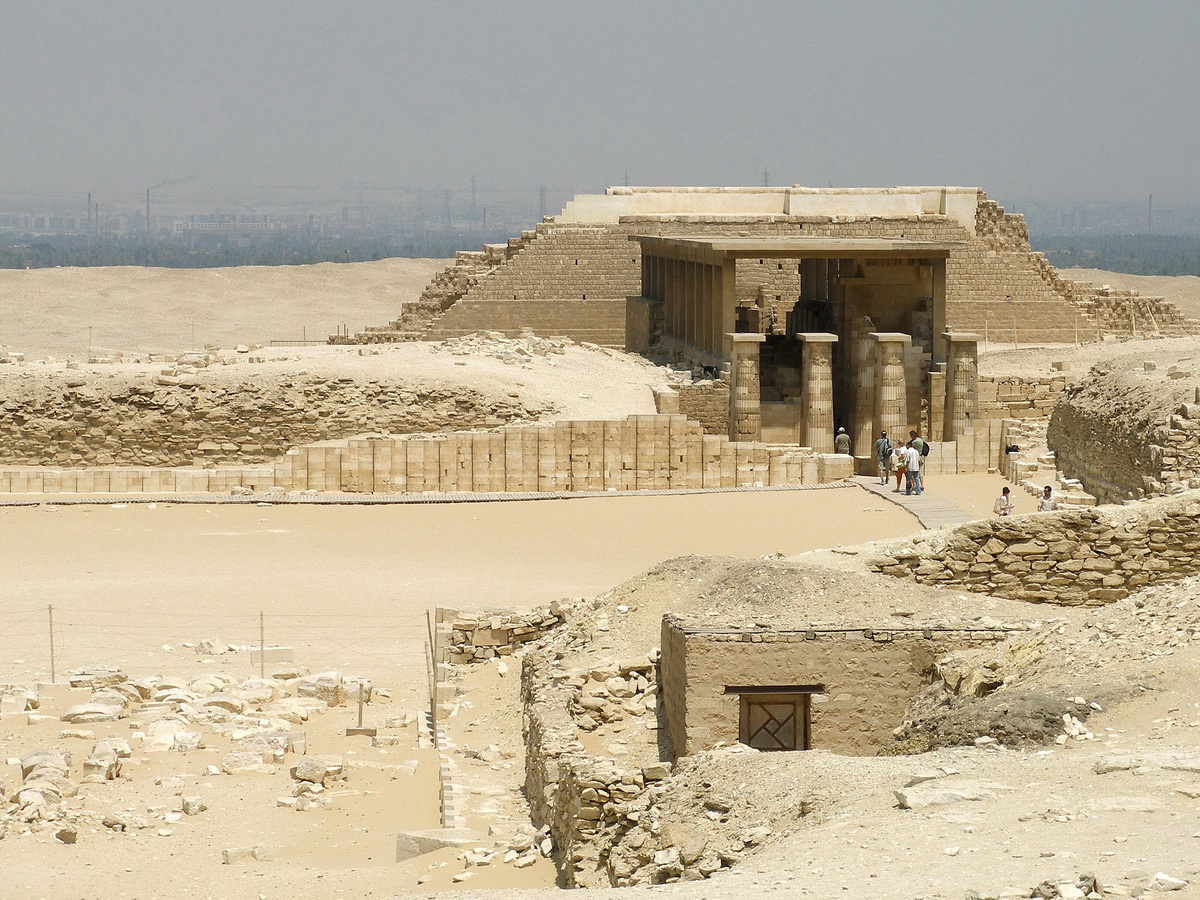
 A remarkable discovery in Egypt has revealed a family statue unlike any seen before. A study in The Journal of Egyptian Archaeology by Dr. Zahi Hawass and Dr. Sarah Abdoh highlights the significance of this limestone sculpture, recovered in 2021 from Gisr el-Mudir in Saqqara.
The central figure is a nobleman, standing with his left foot forward – a traditional Old Kingdom pose that symbolizes youth, strength, and vitality. He wears a short, locked wig and a half-goffered kilt, and the sculptor carefully emphasized his upper body, including the shoulders, clavicle, chest, and arms, to convey both elegance and physical presence.
Next to him kneels a smaller female figure, likely his wife, holding onto his right leg. She wears a shoulder-length wig, a broad collar, and a simple sheath dress. This intimate pose mirrors other Old Kingdom family statues, such as the royal statue of Djedefre, where the queen is depicted squatting beside her husband with her arms wrapped around his leg and her face resting against it.
The most striking feature of this statue is the young girl, probably the nobleman’s daughter, who is carved in bas-relief rather than in the round, a first for Egyptian family statues. She is positioned behind her father’s left leg, extending her right arm to hold onto him while holding a goose in her left hand – a possible symbol of provisions for the afterlife. Dr. Hawass explains, “It was common during the Old Kingdom to depict this scene. Since there are no preserved wall scenes in this tomb, the statue of the daughter holding a goose may have served the same function, representing provisions for the afterlife.”
The statue was found without context in the sands of Gisr el-Mudir, likely discarded by tomb robbers. Nevertheless, stylistic analysis links it to the 5th Dynasty. Its closest parallel is the statue of Irukaptah, housed in the Brooklyn Museum. Both statues share nearly identical proportions, facial features, body positions, and attire. The key differences are that Irukaptah’s son is depicted in the round, while the Gisr el-Mudir daughter is in bas-relief, and the wives’ positions are reversed.
This discovery makes the Gisr el-Mudir statue a one-of-a-kind artifact from the Old Kingdom. The depiction of a family member in bas-relief is unprecedented, shedding new light on Egyptian artistic practices. Likely dating to the 5th Dynasty, the statue offers a rare glimpse into familial representation and creative expression in ancient Egypt.