
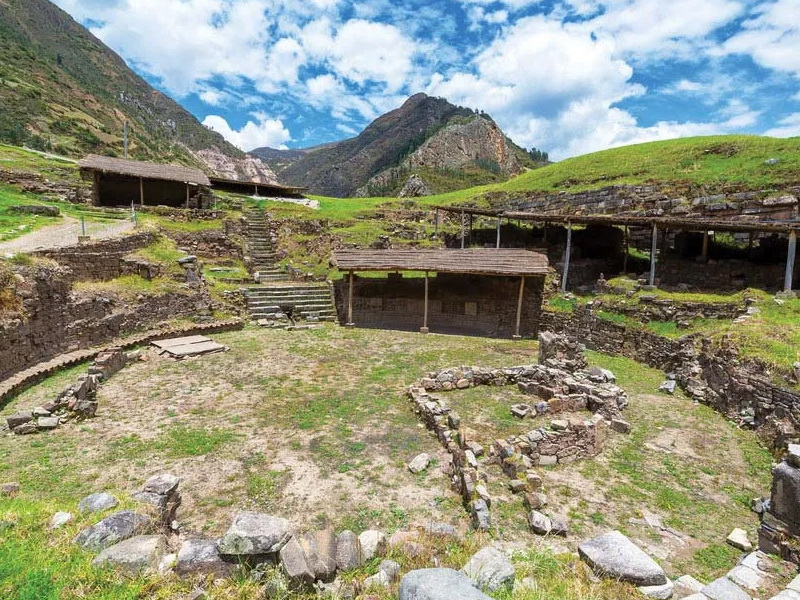
 The Chavin de Huantar complex, thriving from roughly 900 to 200 BC, served as the ultimate religious and cultural anchor for the central Andes. Positioned at a high-altitude confluence known as a tinku where two rivers meet, this immense stone temple complex functioned as the heart of a highly sophisticated cult devoted to the Staff God. The leaders of the Chavin religion expertly combined sensory deprivation, architectural engineering, and hallucinogenic plants to guide visiting pilgrims through a profound transformation into divine entities.
The Staff God and Cosmic Dualism
At the pinnacle of the Andean pantheon sat the Staff God, an enduring figure whose iconography would persist through later civilizations such as the Tiwanaku and the Inca. The deity is traditionally represented holding two distinct staffs, one male and one female, or representing the opposing realms of the coast and the highlands. This imagery perfectly captured the traditional Andean principle of Yanantin, which emphasizes the balance of complementary opposites. To project supreme power, the deity blended human characteristics with apex predators, featuring prominent fangs, sharp claws, and hair composed of living snakes, drawing inspiration from the jungle jaguar and the harpy eagle.
The Lanzon Oracle
Deep within the subterranean chambers of the Old Temple stands the Lanzon, a 15-foot monolithic pillar of white granite carved to resemble a massive spear or traditional digging stick. This sacred monument is concealed inside a pitch-black labyrinth of underground stone galleries. Pilgrims navigated these freezing, narrow corridors in complete darkness until they suddenly faced the snarling visage of the carving, illuminated solely by a precise, hidden light shaft. Structurally, the Lanzon pierces both the floor and the ceiling, serving as an axis mundi that structurally and spiritually linked the underworld, the earthly plane, and the heavens.
Psychoacoustics and Sound Manipulation
The builders of Chavin possessed an advanced understanding of acoustic engineering, constructing an intricate network of stone water channels directly beneath the temple floors. By diverting river water into these subterranean paths, they generated a deep, resonant roar echoing through stone vents that closely mimicked the vocalizations of a jaguar. To heighten the sensory confusion, priests sounded Pututus, which were trumpets crafted from large conch shells. The resulting echoes thoroughly disoriented travelers navigating the complex under the influence of ritual stimulants.
The San Pedro Ritual and Tenon Heads
Transformation remained the core objective of the Chavin experience, as visitors sought to embody the traits of the deity itself. Priests facilitated this process by administering preparations of the San Pedro cactus, a plant rich in mescaline that induced powerful auditory and visual hallucinations. This physical and psychological transition is recorded in the stone Tenon Heads fixed to the exterior walls of the temple. These sculptures capture the human face in various stages of metamorphosis, depicting bulging eyes, nasal secretions caused by the plant, and emerging fangs as the subject shifts into a predatory feline.
Architectural Expansion and Design
Over generations, the complex expanded significantly, transitioning from the Old Temple layout to the New Temple design. A central feature of this expansion was the Sunken Circular Plaza, a large open-air amphitheater used for communal ceremonies, adorned with stone reliefs of mythical entities carrying San Pedro cacti alongside jaguars. The entrance to the New Temple was marked by the Black and White Portal, a monumental gateway constructed from contrasting black limestone and white granite, a design choice that explicitly reinforced the cultural focus on duality.
The Chavin Horizon and Cultural Continuity
The widespread impact of this site is recognized archaeologically as the Chavin Horizon, marking the initial era where a unified religious art style linked the scattered populations of the Peruvian coast and mountain regions. Long-distance travelers brought valuable offerings, including obsidian and Spondylus shells, and returned to their homelands with Chavin artistic conventions and textile patterns. Although the complex was abandoned around 200 BC, its core iconography, particularly the Staff God and feline symbolism, laid the structural foundation for subsequent Andean societies, including the Moche, Nazca, and Inca.