
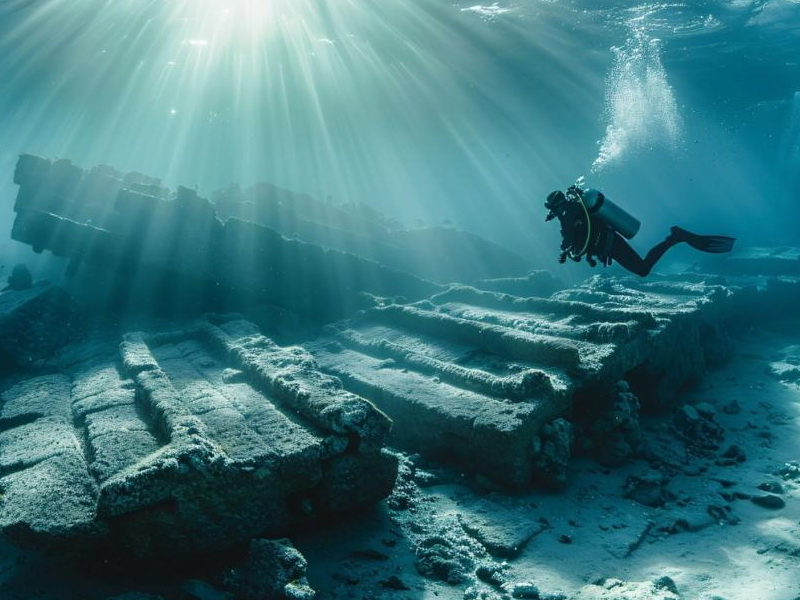
 Archaeologists have made a landmark discovery that may finally reveal the location of Cleopatra’s tomb. Led by Dominican archaeologist Dr. Kathleen Martinez and renowned marine explorer Dr. Robert Ballard, the team has uncovered a submerged ancient port off the Egyptian coast near Taposiris Magna. This finding highlights the temple complex’s importance during Cleopatra’s reign, suggesting it played a far more significant role than previously understood.
Ancient Port Unearthed
The discovery caps nearly two decades of research at Taposiris Magna, located approximately 30 miles (48 km) west of Alexandria. The Egyptian Ministry of Tourism and Antiquities confirmed the existence of an ancient harbor directly linked to the temple through an underwater tunnel system. Advanced sonar mapping revealed massive stone structures arranged in systematic rows beneath the Mediterranean Sea. Dr. Ballard’s team identified stone and metal anchors, numerous Ptolemaic-era amphorae, and a highly polished floor among the submerged ruins.
Geological surveys indicate that the ancient coastline was about 2.5 miles (4 km) inland from today’s shore. This shift likely resulted from centuries of seismic activity, including at least 23 earthquakes recorded between 320 and 1303 AD, which caused parts of the port to sink. Martinez believes the submerged structures may have facilitated the transport of Cleopatra’s remains to the temple complex.
Tunnel Systems and Archaeological Evidence
The underwater port connects to a 4,300-foot tunnel uncovered by Martinez’s team in 2022. Situated 40 feet underground and partially flooded, the passage extends from the temple toward the Mediterranean. Archaeologists discovered ceramic jars and Ptolemaic pottery within, providing crucial evidence for dating the artifacts.
Further exploration revealed an extension of the tunnel system in an area called “Salam 5,” where divers found artifacts indicating ancient maritime activity. Among these were rectangular stone structures, basalt pedestals mirroring those at the temple, and the “Three Sisters” formation—three closely positioned pillars.
Taposiris Magna as a Maritime Hub
The newly uncovered port suggests that Taposiris Magna was a major maritime trading hub during Cleopatra’s reign from 51 to 30 BC. This aligns with historical accounts of Cleopatra’s sophisticated naval operations and her strategic use of Egypt’s Mediterranean connections for political and economic purposes.
Dr. Mohamed Ismail Khaled, Secretary General of Egypt’s Supreme Archaeological Council, emphasized that historical sources had never referenced this port, enhancing the significance of the discovery. Evidence shows the harbor was protected by natural reefs and featured advanced infrastructure for ancient shipping.
Artifacts and Historical Insights
Previous excavations at Taposiris Magna have yielded over 2,600 artifacts, including 337 coins bearing Cleopatra’s image, bronze statues, oil lamps, and ceremonial objects. Inscriptions in Greek and hieroglyphics on the temple’s foundation deposits dedicate the structure to the goddess Isis, with whom Cleopatra closely identified.
Martinez theorizes that Cleopatra may have orchestrated a plan to hide her body alongside Mark Antony’s, evading Roman discovery. The queen’s connection to Isis worship and the temple’s dedication support this hypothesis.
Ongoing Research and Future Excavations
Collaborative research continues, focusing on further underwater excavations at “Salam 5” using specialized drilling equipment and diving teams. Dr. Ballard has mapped approximately six miles of underwater terrain, providing a comprehensive guide for ongoing and future exploration efforts.