
 The myth of the Minotaur, a creature with the body of a man and the head of a bull, imprisoned within a labyrinth beneath King Minos’s palace, remains one of the most famous stories of Greek mythology. Originating from Crete and connected to the ancient Minoan civilization, this tale blends myth with hints of historical and cultural realities. But how much is pure legend, and how much reflects the world of the Minoans?
The Myth of the Minotaur
According to Greek legend, the Minotaur was born as a result of a curse on Queen Pasiphae, wife of King Minos. When Minos failed to sacrifice a sacred bull to Poseidon, the god caused Pasiphae to fall in love with the animal. The union produced the Minotaur, a monstrous being with a man’s body and a bull’s head.
Unable to kill the creature, Minos had the master craftsman Daedalus construct a vast labyrinth to confine it. Athens was compelled to send seven boys and seven girls every nine years to Crete as a tribute, to be offered to the beast. The cycle ended when the Athenian hero Theseus volunteered to enter the labyrinth. With a ball of thread given by Minos’s daughter Ariadne, he navigated the maze, killed the Minotaur, and escaped—turning the myth into a story of heroism and liberation.
Minoan Culture and Mythological Echoes
Though fantastical, the myth may reflect aspects of the Minoan civilization, which flourished on Crete between roughly 2600 and 1100 BCE. The Minoans were a powerful maritime society, known for advanced architecture, sophisticated art, and their undeciphered script, Linear A.
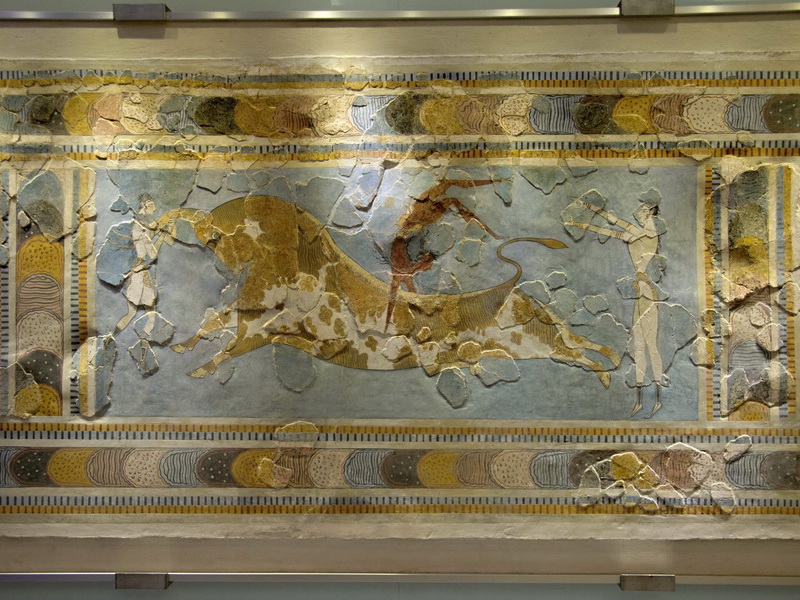
Bulls held a central place in Minoan culture. Frescoes and figurines showing bull-leaping rituals have been found at Knossos, suggesting ceremonial or religious significance. This recurring bull imagery may have inspired the myth of the bull-headed Minotaur.
The Labyrinth and Knossos
The labyrinth is a defining feature of the myth. While no literal maze has been discovered, the Palace of Knossos may have served as its inspiration. Excavated by Sir Arthur Evans in the early 20th century, the sprawling, multi-level complex contains interconnecting corridors, staircases, and rooms. Evans associated the site with the myth, dubbing it the “Palace of Minos.”
Modern scholars debate his conclusions. While Knossos is extensive and intricate, it lacks evidence of a true maze. Yet, its scale, rich bull symbolism, and political-religious significance make it a plausible source for the labyrinth legend.
Archaeological Clues
Several findings suggest connections between the myth and Minoan culture:
Bull-leaping frescoes: Acrobats vaulting over bulls, highlighting ceremonial or ritual importance.
The Double Axe (Labrys): A sacred symbol frequently found in Minoan sites, possibly linked to the word “labyrinth.”
Potential evidence of ritual sacrifice: Remains at sites like Anemospilia suggest ritual killings, though interpretations remain debated.
Where Myth and History Intersect
The Minotaur myth demonstrates how legend can preserve cultural memory. While there is no evidence of an actual half-man, half-bull monster beneath Knossos, the story reflects elements of Minoan life—the prominence of bulls, architectural complexity, and interactions with the Greek mainland.
It also conveys ancient Greek perspectives on Crete, portraying Athens as a heroic liberator against Cretan authority. In this way, the legend of the Minotaur endures both as a captivating myth and as a symbolic echo of historical realities.